History
Why Do Coins Have Ridged Edges? The Anti-Clipping History
Why do dimes and other coins have ridges? Discover coin clipping, milled edges, England’s 1696 recoinage and Isaac Newton’s Mint role.
Updated 3 min read

In this story
The edge of a coin is easy to ignore. Yet some coins have a precise ring of tiny grooves, known as a reeded edge, while others are smooth or carry lettering. The pattern is not just a decorative flourish. It has roots in a time when money could literally be shaved away.
When the coin’s metal was the money
Many older coins were made from silver or gold, and their value was closely connected to the precious metal they contained. That created an opportunity. Someone could trim tiny pieces from the edge of a coin, keep the metal, and attempt to spend the lighter coin as if it were whole.
One clipped coin might not look dramatically different. A large number of clipped coins, however, could undermine trust in the circulating currency. People became uncertain whether the metal in a coin matched its official value.
A smooth edge made tampering harder to spot. A consistent pattern around the rim offered an elegant visual test: if the pattern disappeared or became uneven, someone might have removed metal.
The Great Recoinage of 1696
England faced a serious currency problem in the late seventeenth century. Hand-struck silver coins had circulated for many years, and clipping and counterfeiting made their condition increasingly unreliable.
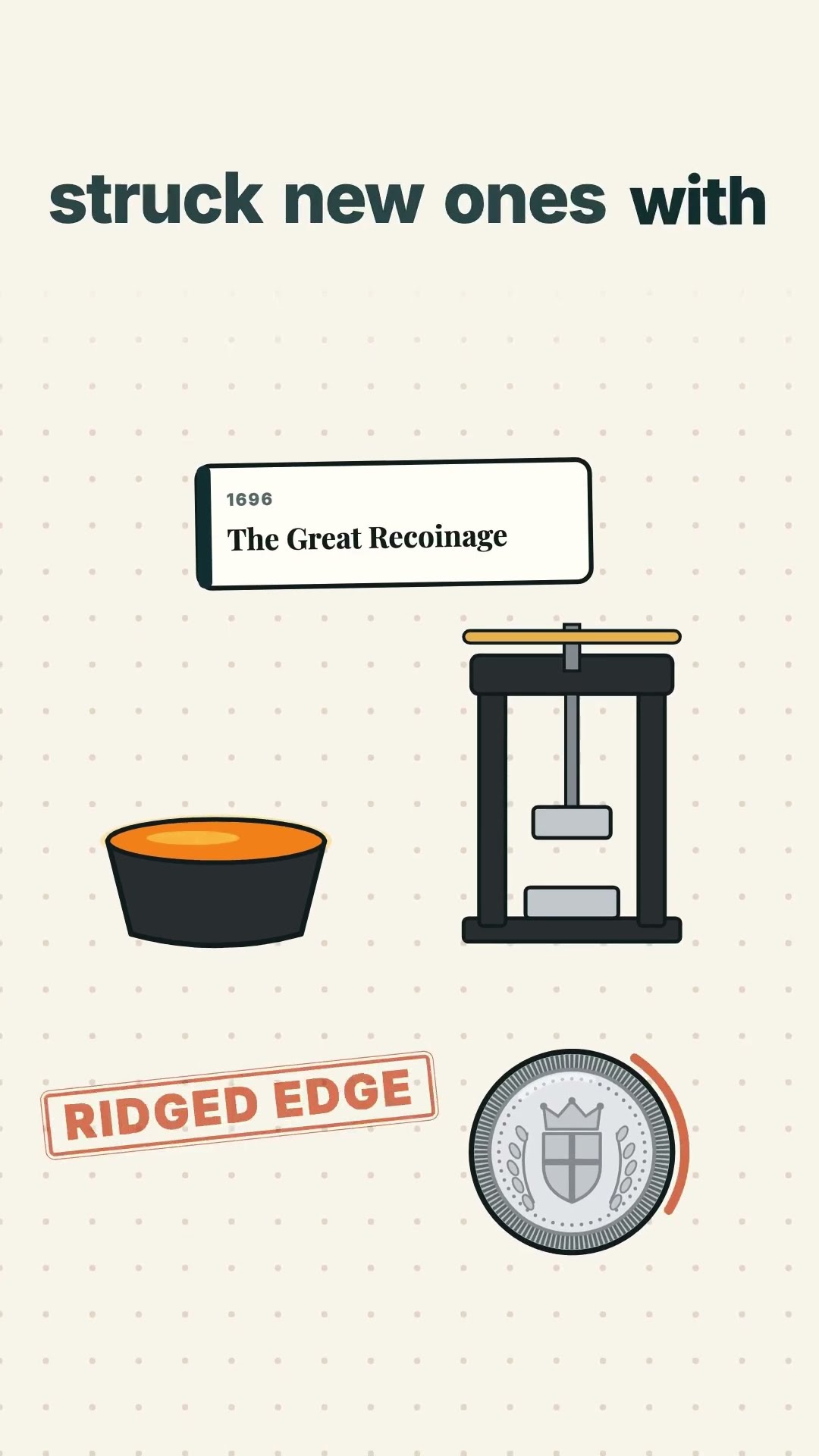
In 1696, the government launched a major effort to melt down and replace older silver coins. The University of Oxford’s history of the Great Recoinage explains how mechanically made coins with carefully formed edges were part of that response.
Crucially, milled coin edges were not invented in 1696. The Royal Mint notes that such mechanical methods had been introduced earlier in the seventeenth century. What made the recoinage important was their broader use in rebuilding confidence in the currency.
What did Isaac Newton have to do with it?
Isaac Newton is famous for physics and mathematics, but he also worked at the Royal Mint. He became Warden of the Mint in 1696, then Master of the Mint in 1699.
Newton did not invent the concept of a ridged edge. His role was administrative, technical, and investigative. He helped improve Mint operations and pursued those suspected of clipping or counterfeiting coins. The Royal Mint’s historical teaching materials describe those efforts.
The connection is a striking one: a scientist whose name is associated with the laws of motion also spent years dealing with the practical problem of trustworthy money.
Why do modern coins still have ridges?
Most everyday coins are no longer valued simply as their weight in silver or gold. That means anti-clipping is less relevant for ordinary modern change. But edge designs remain useful.
A reeded edge can make one denomination distinguishable from another by touch. Edge shapes, inscriptions, and combinations of smooth and grooved sections can also serve as identification and anti-counterfeiting features.
Not every coin has ridges. Minting authorities select edge designs based on cost, accessibility, recognition, tradition, and security requirements.
One tiny detail with a big purpose
The coin in your pocket reflects centuries of people trying to agree on a simple question: how do you know this piece of money is what it claims to be? A pattern at the edge made tampering visible without requiring a scale or laboratory.
That is why a small manufacturing detail outlasted the original crime it was designed to expose.
Frequently asked questions
What are the ridges on a coin called?
The common term is reeding. Coins may also feature lettering, ornamental milling, or smooth edges.
Did Isaac Newton invent ridged coin edges?
No. Mechanically produced edge designs preceded his Mint service. Newton was involved in the 1696 recoinage and enforcement against currency crimes.
Why are some coins smooth?
Different denominations and minting systems use different edge styles. A smooth edge does not automatically mean a coin is counterfeit.
Short film
Why Does Your Coin Have Tiny Lines?
youtube · 0:43
The short uses the same reporting as this article. No third-party player is loaded on this page.
Watch on youtubeSources
- Clippers and Counterfeiters — Royal Mint
- The Great Recoinage — Oxford

Creator
Funda Tabak
PMP® certified project manager. She has coordinated IdeallyFree’s content since 2010. Full bio
This story is for general understanding. It is not safety, legal, or technical advice.