Technology
The Magnetic Stripe Card Was Made Possible by a Clothes Iron
How a household clothes iron helped IBM engineer Forrest Parry attach magnetic tape to a plastic card—and changed payments worldwide.
Updated 3 min read

In this story
For decades, a strip of dark material on the back of a plastic card made it possible to identify people, authorize payments, and access secure buildings. The engineering breakthrough behind that stripe has an unexpectedly domestic detail: a clothes iron.
The challenge: putting computer data on a card
Magnetic tape was already used to store information in audio systems and computers. Its surface contained magnetic material that could be arranged to represent data. What if a small piece of that material could be attached to something as convenient as a plastic identification card?
Parry was working on a more secure identification concept for government use. The idea made sense: instead of relying only on printed text or a visible badge, a card could carry machine-readable information.
But a clever concept is not the same as a manufacturable product. Early attempts to attach the magnetic tape securely to plastic were problematic. An unreliable bond would leave the stripe vulnerable to peeling or failing during ordinary handling.
The ironing-board solution
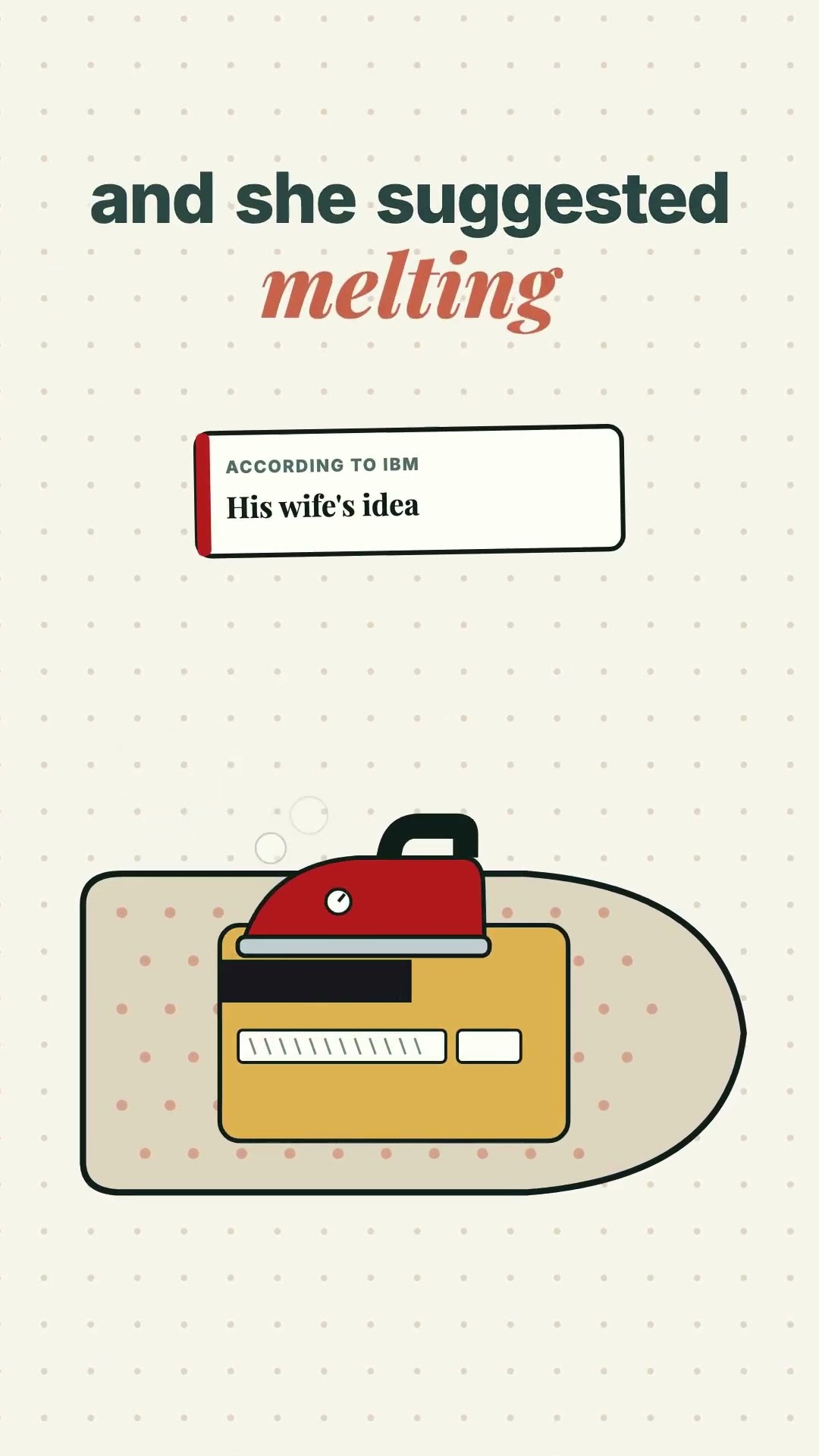
IBM’s official account of the magnetic stripe says Parry discussed the adhesion problem at home while his wife was ironing clothes. She suggested using the iron to apply heat, bonding the magnetic material to the plastic card.
It worked. The significance was not that a household iron became a standard industrial manufacturing machine. The significance was the realization that heat bonding could solve the attachment problem.
That insight turned a useful idea into a more practical physical object: a card that could carry information and survive normal use.
How does a magnetic stripe store information?
A magnetic stripe contains particles of magnetic material embedded in a thin layer. A recording system changes magnetic orientation in controlled patterns, creating information that a suitable reader can detect.
When a card is swiped past a reader head, the reader senses changes in the magnetic field and translates the pattern into data. The technology does not depend on printing a long number that a machine visually recognizes. The information is encoded in magnetism.
This was especially valuable when computer systems were growing rapidly but contactless chips, smartphones, and modern networks were not yet part of everyday life.
From identity badges to payments
Magnetic-stripe cards spread into multiple industries. Banks, retailers, transit systems, and other organizations adopted machine-readable cards because the form factor was small and familiar.
Standardization made them much more useful. A card reader had to understand the data layout and physical stripe dimensions reliably, otherwise cards from different organizations would become incompatible.
The technology helped create the infrastructure of electronic payments and access systems. It was never the only ingredient—banking networks, terminals, standards, and fraud controls mattered too—but the magnetic stripe was a powerful enabling component.
Why are magnetic stripes disappearing from some cards?
Magnetic stripes are relatively simple to read and can be easier to copy than modern chip-based credentials. Payment systems increasingly rely on EMV chips, contactless technology, and other mechanisms designed to reduce certain kinds of fraud.
That does not make the magnetic stripe unimportant. Its extraordinary longevity shows what happens when a cheap, standardized interface solves a common problem well enough to spread globally.
The bigger lesson
Innovation often happens at the point where a technically sophisticated idea meets an ordinary physical problem. Parry did not need a new theory of magnetism to solve the sticking issue. He needed a better way to attach two materials.
The machine-readable card helped change modern commerce—and one memorable step in its history started in a room where someone was ironing clothes.
Frequently asked questions
Who invented the magnetic-stripe card?
IBM credits Forrest Parry with pioneering the attachment of magnetic media to a plastic data card.
Did a clothes iron really play a role?
Yes. IBM recounts that Parry’s wife proposed using an iron to heat-bond the magnetic tape to the plastic.
Are magnetic stripes the same as chip cards?
No. A magnetic stripe stores relatively simple magnetic data, while a smart chip performs more complex security operations.
Short film
The Wife Who Saved the Credit Card Industry 💡
youtube · 0:53
The short uses the same reporting as this article. No third-party player is loaded on this page.
Watch on youtubeSources
- The Magnetic Stripe — IBM

Creator
Funda Tabak
PMP® certified project manager. She has coordinated IdeallyFree’s content since 2010. Full bio
This story is for general understanding. It is not safety, legal, or technical advice.