Technology
How Does “I’m Not a Robot” Work? It’s Not Just the Checkbox
Clicking “I’m not a robot” seems too easy. Learn how reCAPTCHA uses risk signals and when it asks for image challenges.
Updated 3 min read

In this story
A website asks you to prove you are human. You click a tiny box labeled “I’m not a robot.” A green checkmark appears. That’s it. If a computer can click a box too, what exactly did the test prove?
The checkbox is the visible part of a bigger test
A conventional HTML checkbox is easy for a script to activate. So the reCAPTCHA checkbox would be a weak anti-bot defense if the system relied only on whether it had been clicked.
Instead, the checkbox is part of a security flow. Google’s official documentation explains that the familiar reCAPTCHA v2 checkbox may pass a visitor immediately or present an additional challenge. Other versions can operate without an obvious checkbox and return an assessment of risk.
The real question is not “Can this visitor click?” but “Does this interaction appear legitimate given the signals available to the system?”
Does reCAPTCHA watch your mouse?
User behavior can contribute to automated risk assessment. Signals related to interaction patterns can make it harder for simplistic automation to imitate a person.
But the viral explanation that bots move in perfectly straight lines while humans make wobbly paths is not a reliable description of how modern reCAPTCHA works. Many real users navigate by keyboard or touchscreen, and automated tools can imitate complex cursor movements.
Google’s reCAPTCHA product overview discusses broad categories of risk signals, including behavior, device information, and historical interaction patterns. It does not publish a simple rule such as “curved mouse path equals human.”
Why does it ask for pictures sometimes?
When a system is less confident about an interaction, a visitor may be challenged to identify objects in images: traffic lights, bicycles, buses, or crosswalks. The point is to make unauthorized automation more difficult while allowing many legitimate visitors to pass with less friction.
Image challenges are not flawless. People make mistakes, ambiguous image boundaries can be frustrating, and visual-only tasks create serious accessibility issues for some users.
The W3C’s analysis of CAPTCHA accessibility explains that distinguishing machines from people should not depend solely on tasks that exclude people with disabilities.
What data is part of a risk assessment?
The exact mix depends on the reCAPTCHA product, site integration, configuration, and changes made over time. Public information supports a broad description: systems can consider patterns of behavior, environment, and prior interactions.
That is different from claiming that Google always reads one particular cookie or stores every motion in the same way. Product implementations evolve, and privacy consequences depend on the integration and applicable policies.
Websites should tell users about relevant third-party processing and comply with their own privacy obligations. Users should also understand that a CAPTCHA is a security tool, not a guarantee that all abuse has been stopped.
Why does a legitimate user sometimes fail?
Risk-based systems make imperfect judgments. A shared network, privacy tools, unusual browsing setup, automation-like activity, or accessibility-related interaction can lead to additional challenges. This does not mean the user is a robot.
The broader lesson is that the apparently simple checkbox is just an interface for a more complicated decision. The website is evaluating confidence, not asking you to swear an oath.
Frequently asked questions
Can a bot click “I’m not a robot”?
Of course. Clicking the box is easy; the challenge is passing the surrounding risk assessment.
Does reCAPTCHA only track mouse movement?
No. Google’s published descriptions refer to multiple risk signals, and different versions behave differently.
Why am I sometimes asked to select traffic lights?
The system may request a visual challenge when it needs more evidence that an interaction is legitimate.
Short film
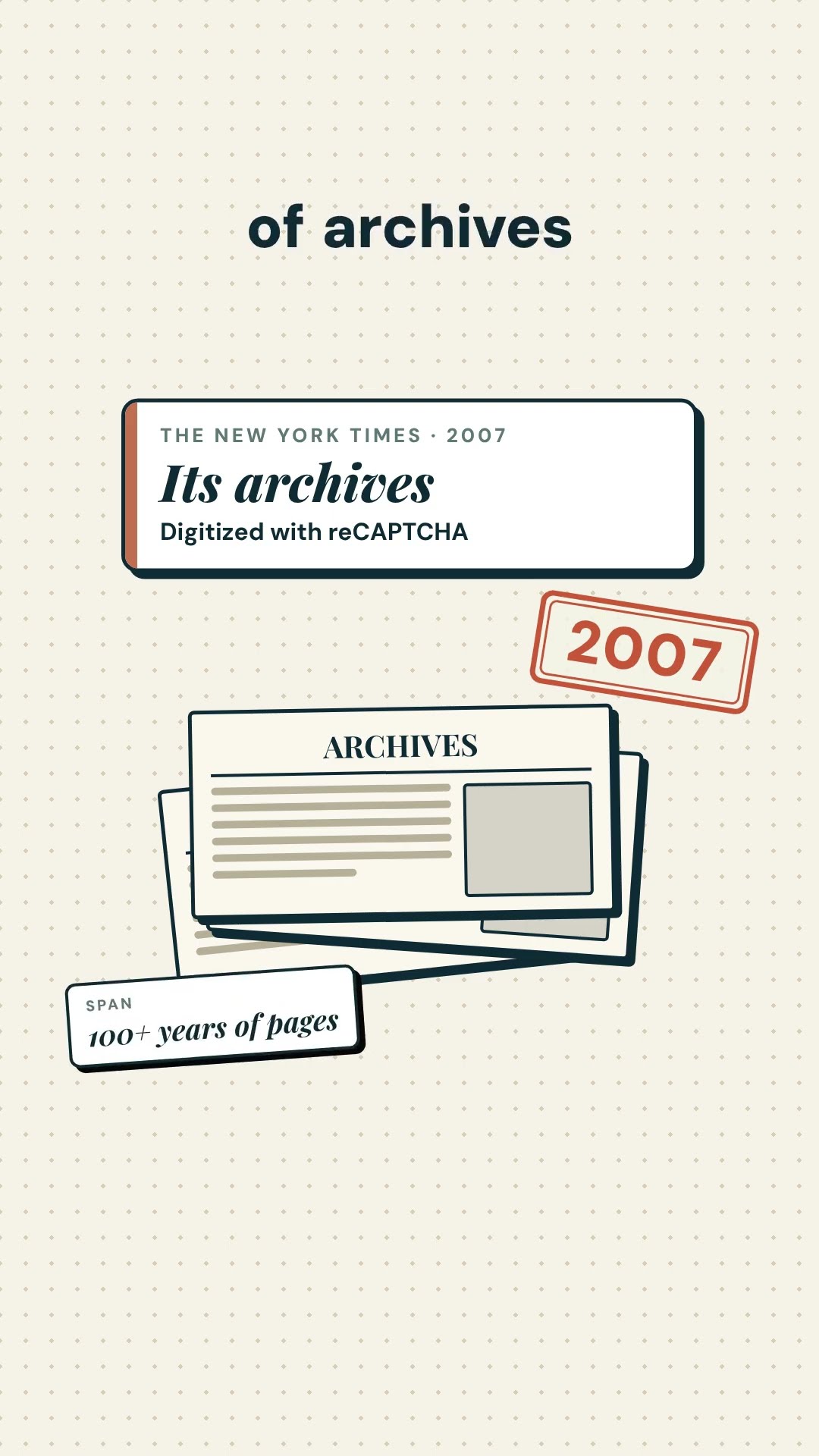
You've typed those warped words a thousand times. You weren't just proving you were human.
youtube · 0:38
The short uses the same reporting as this article. No third-party player is loaded on this page.
Watch on youtubeSources
- reCAPTCHA Versions — Google
- reCAPTCHA Risk Analysis — Google Cloud
- Inaccessibility of CAPTCHA — W3C

Creator
Funda Tabak
PMP® certified project manager. She has coordinated IdeallyFree’s content since 2010. Full bio
This story is for general understanding. It is not safety, legal, or technical advice.