Science
Einstein’s Forgotten Refrigerator: The 1930 Invention
Einstein and Leo Szilard designed a refrigerator to address deadly refrigerant leaks. Explore their 1930 patent and why it never went mainstream.
Updated 3 min read

In this story
Albert Einstein’s name usually brings to mind relativity, black holes, and equations. A refrigerator seems like an unlikely addition to that list. Yet in the 1920s, Einstein and fellow physicist Leo Szilard worked on a cooling system motivated by a very practical danger in the home.
Why old refrigerators could be dangerous
Before modern refrigerants and safety systems became widespread, domestic refrigeration could use chemicals that were hazardous if released inside a home. Newspaper reports of serious and sometimes deadly leaks drew attention to the problem.
The German Patent and Trade Mark Office recounts how a fatal household refrigeration accident influenced Einstein’s interest in safer designs. Szilard, a talented Hungarian physicist who had studied in Berlin, joined him in exploring alternatives.
Their problem was not how to make things cold in principle. Refrigeration was already possible. The challenge was how to make a system reliable enough that dangerous working fluids would be less likely to escape.
The appeal of a design without moving mechanical parts
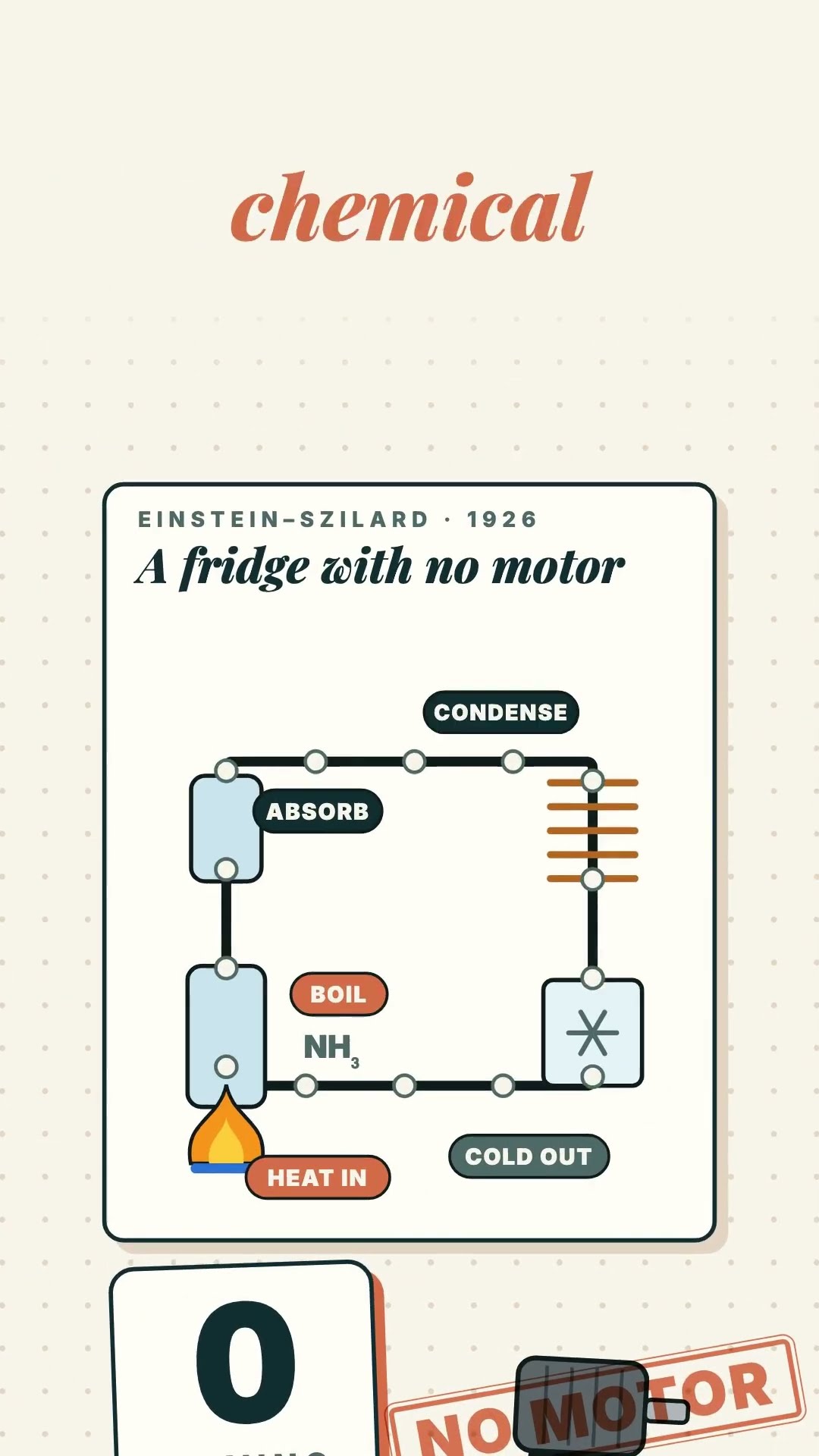
Mechanical components such as valves, seals, and pumps can develop faults. Einstein and Szilard investigated ways to minimize those weaknesses. They explored absorption-based processes and an electromagnetic pump that used an electromagnetic field to move liquid metal rather than relying on ordinary moving pump mechanisms.
That distinction matters. It is often said that they invented a refrigerator with “no moving parts.” More accurately, they worked on designs without conventional mechanically moving pump parts. Fluids still moved through the system, and different designs used different physical arrangements.
The Smithsonian Lemelson Center explains how the electromagnetic approach was part of their effort to reduce leaks at moving seals.
How did the Einstein–Szilard refrigerator work?
Refrigerators move heat from a cooler compartment to a warmer environment. Conventional compressor refrigerators generally accomplish this using a motor-driven compressor and a circulating refrigerant.
Einstein and Szilard explored alternative methods. Some relied on heat-powered absorption processes; one notable design used an electromagnetic pump. The resulting systems were technically interesting, but engineering a working, affordable, efficient product was another challenge entirely.
It is also misleading to describe the device simply as a refrigerator that ran on “chemical reactions.” Refrigeration depends on thermodynamic processes such as evaporation, absorption, pressure changes, and heat transfer, not on consuming a chemical reaction in the everyday sense.
What happened in 1930?
Their refrigeration research generated several patent applications. A notable U.S. patent, No. 1,781,541, was granted in 1930. The American Physical Society’s historical account discusses the invention and the difficulties of developing the electromagnetic system.
Commercial interest did exist, but competing technologies improved rapidly. Refrigerators with conventional compressors became more practical and widely adopted, while refrigerants and safety engineering evolved.
The Einstein–Szilard approach did not become a standard kitchen appliance. Its importance lies in showing how fundamental physics could be directed toward a concrete consumer safety problem.
Was Einstein trying to make a silent refrigerator?
Quiet operation was an attractive goal for some alternative refrigeration systems, but describing every Einstein–Szilard design as silent would be inaccurate. Historical accounts describe problems with noise in the electromagnetic pump prototypes.
That is part of the story’s charm: even exceptionally talented physicists had to contend with vibration, materials, cost, and the unglamorous details of manufacturing.
Frequently asked questions
Did Einstein actually invent a refrigerator?
Yes. He co-developed and patented refrigeration technologies with Leo Szilard, though these were not the everyday refrigerators found in most homes.
Why wasn’t the Einstein refrigerator widely sold?
The designs faced engineering and commercial obstacles while conventional compressor refrigeration improved and became dominant.
Did the design have a motor?
Some concepts replaced conventional moving mechanical compressor components with other mechanisms, including an electromagnetic pump. The precise answer depends on which patented design is being discussed.
Short film
Einstein Once Tried to Fix Your Fridge
youtube · 0:46
The short uses the same reporting as this article. No third-party player is loaded on this page.
Watch on youtubeSources
- Einstein — German Patent and Trade Mark Office
- Einstein-Szilard Refrigerator — Smithsonian Lemelson Center
- 1930 Patent — American Physical Society

Creator
Funda Tabak
PMP® certified project manager. She has coordinated IdeallyFree’s content since 2010. Full bio
This story is for general understanding. It is not safety, legal, or technical advice.