Everyday Life
Why Do Sidewalks Have Yellow Bumps? The Story of Tactile Paving
Discover tactile paving, why warning dots differ from guiding bars, and how Japanese inventor Seiichi Miyake pioneered the system in 1965.
Updated 3 min read

In this story
You have probably felt the bumpy yellow tiles near a pedestrian crossing or the edge of a train platform. They can look like decorative paving or a way to make a sidewalk more visible. Their actual purpose is much more important: they communicate information through touch.
A surface you can read without seeing
Tactile paving works by placing a recognizable texture beneath a person’s shoes or mobility cane. A change in surface pattern can signal that the environment is changing.
Common examples include:
- Raised dots or domes: Often used to draw attention to a hazard or transition, such as the edge of a platform or a street crossing.
- Long raised bars: Often used as directional guidance along a route.
These conventions are widespread, but their exact dimensions, arrangements, placement, and meanings can differ between countries and standards. They should not be described as a universal two-word language where every dot always means “stop” and every bar always means “go.”
Who invented tactile paving?
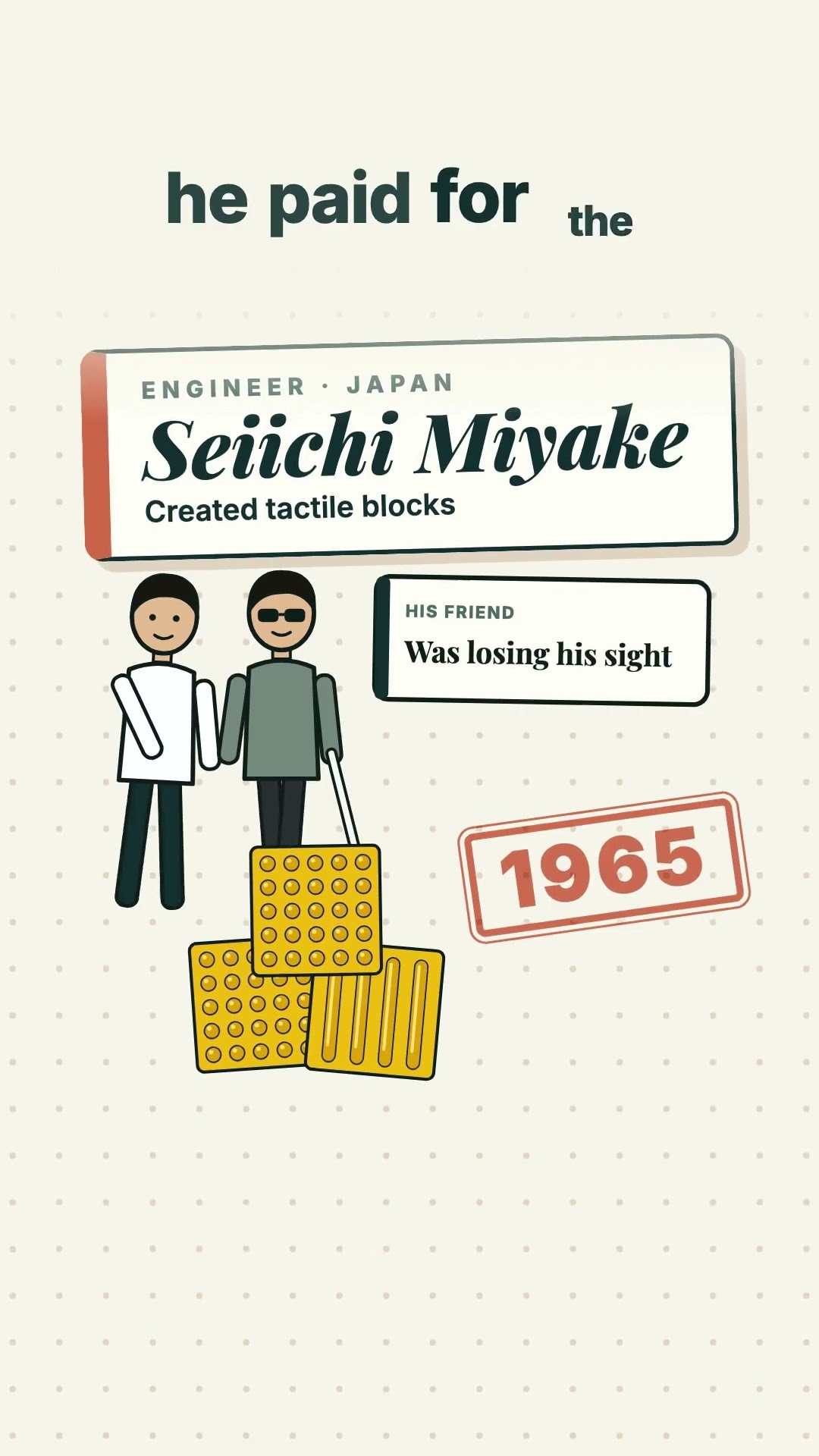
Seiichi Miyake, a Japanese inventor, began developing tactile blocks to help a friend who was losing his sight. The early designs were known as Tenji blocks.
According to Google’s historical feature about Miyake, he funded the development himself in 1965. The first installation took place on March 18, 1967, on a street near the Okayama School for the Blind.
What makes the story memorable is its starting point. Rather than beginning as a giant nationwide infrastructure program, the idea emerged from a desire to help someone navigate more independently.
Why are the tiles often yellow?
Color contrast can help people who have some usable vision. A bright tile against a darker sidewalk or platform can be easier to distinguish than two surfaces with similar tones.
But the yellow color is not the defining invention. The raised texture conveys information by touch. In some countries, tactile paving uses different colors depending on the surrounding pavement and local standards.
A useful installation needs both tactile information and thoughtful placement. Incorrectly installed paving can create confusion or lead people toward obstacles rather than away from them.
From one Japanese street to global infrastructure
The concept spread through Japanese transport systems before becoming familiar in many countries. Railway stations, sidewalks, transit stops, crossings, and public buildings adopted various tactile warning or guidance surfaces.
The broader accessibility movement also shaped standards and implementation worldwide. Today, different national guidance documents specify how detectable warnings and directional patterns should be designed.
Miyake’s original invention is rightly celebrated, but tactile accessibility also depends on decades of work by blind and low-vision people, disability advocates, engineers, and public agencies.
Can you feel the pattern through shoes?
Yes, that is part of the design intent. People may recognize tactile paving through the soles of their shoes or via a long cane. How easily a person notices the surface depends on footwear, the type of tile, the person’s mobility technique, and surrounding conditions.
Tactile paving is one tool among many. It does not replace accessible crossings, audible information, safe curb design, or clear pedestrian routes.
The next time you cross the street
Those small raised shapes are not random bumps. They are information embedded directly into public space. Their history shows how a modest change to a familiar surface can make a city easier to navigate for people who experience it differently.
Frequently asked questions
What are the yellow bumps on sidewalks called?
They are commonly called tactile paving, detectable warning surfaces, or, in Japan, Tenji blocks.
Do tactile dots and bars always mean the same thing?
They often distinguish warning and directional uses, but exact standards vary by country and setting.
When was tactile paving invented?
Seiichi Miyake developed early tactile blocks in 1965, and they were first installed in Okayama in 1967.
Short film
These bumps were not meant for your feet or eyes!
youtube · 1:00
The short uses the same reporting as this article. No third-party player is loaded on this page.
Watch on youtubeSources
- Celebrating Seiichi Miyake — Google Doodles

Creator
Funda Tabak
PMP® certified project manager. She has coordinated IdeallyFree’s content since 2010. Full bio
This story is for general understanding. It is not safety, legal, or technical advice.